The interface
The chatbot, the copilot, the search box. The smallest part of the system — and the only one most people ever meet.
Physical AI · Digital twins · Applied AI
Industrial Engineer UPC · ETSEIB Head of AI at BTECH
Industrial engineering and artificial intelligence. In practice, almost everything I do starts with someone describing a symptom.
We’re at the start of a new industrial revolution: not just AI, but robotics, digital twins and everything they bring with them. My place in it is clear: to integrate it into everything that already exists and works, and to open up processes that weren’t possible before, digesting and cross-referencing far more information than fits in one head. Used well, it makes us hyper-capable; used badly, it takes away more than it adds. The difference is judgement. Build the future, don’t wait for it.
400
Engineers at the company where I built the AI department
3 months
Of one person’s annual work, cut down to hours on a single process
CEO
Direct reporting line to the CEO
GB10
Own compute, on-premises and on-edge: data never leaves the company.
At a glance
Models that run on-premises: not a single datum leaves the building. On RKE2, the DISA STIG–certified Kubernetes for defence and intelligence (FIPS 140-2), plus agentic systems demoed live.
From CUDA and GB10 to NeMo, NIM and Dynamo. Distributed inference on Kubernetes, a contribution to OpenShell, and part of the Hugging Face open-source community.
Digital twins, finite elements and models that reason over physical systems. From calculation to the real world —down to open-source robotics (Pollen Robotics · Hugging Face) I build for fun.
Computational biology with AlphaFold (up to its latest versions), a glucose-energy thesis for implantable devices with a patent process started, and experience in a regulated pharmaceutical environment.
Where all of the above is heading: digital twins and physics-informed AI on GPU to simulate biology instead of assaying it, and test drugs in silico. Rooted in real bioengineering —the citric-acid cycle and glucose energy for implantable devices— and, from 2026, in the study of the brain: how it learns, decides and fails.
In 60 seconds
Guillem Navarro Vargas, industrial engineer (UPC). Head of AI at BTECH, Barcelona.
What I doAI systems that reach production: enterprise intelligence, digital twins, simulation and Physical AI.
HowAn engineer's method: measure before touching, and on-premise computing when data cannot leave the building.
From whereFrom energy to application: power, GPU and Kubernetes infrastructure, models and product.
ProofNVIDIA certifications, a postgraduate programme with Schneider Electric, and projects in industry, automotive and pharma.
And nowProfessional opportunities —in a team, on a project or as a collaboration— where this makes a difference. An answer within 48 working hours.
What AI really is
For most people, AI is a chatbot you talk to well; that’s just the surface. The real thing is also robotics, digital twins and models that simulate reality to test in it before touching it —solving real problems in pharma, medicine and industry. That’s where I work: not on prompt tricks, but on turning all of it into systems that run. Nobody masters a field this vast and this fast-moving; be wary of anyone who says they do. I keep learning, with my feet in the part that actually transforms things.
The chatbot is the tip: the only part that shows. Beneath it sit entire engineering disciplines — and that is where an AI project succeeds or sinks.
Above the waterline · what almost everyone sees
The chatbot, the copilot, the search box. The smallest part of the system — and the only one most people ever meet.
Below the waterline · where the project is decided
Systems that search an organisation's knowledge, reason over it and act: from answering questions to running entire processes.
Choosing the right model, fine-tuning it on your own data, measuring it properly and fencing it with guardrails before trusting it.
Virtual copies of factories, processes or organs, to test digitally what would be costly or dangerous to test in reality.
AI that leaves the screen: robots trained millions of times in simulation before they touch the physical world.
GPUs, Kubernetes, edge, and on-premise computing when data cannot leave the building. Without this layer, none of the above exists.
The physical base: every AI answer is watts turned into compute. Here the iceberg touches bottom — and the cake begins.
The whole industry, in one picture
It isn't my metaphor. Jensen Huang, NVIDIA's CEO, describes AI as a “five-layer cake” — energy, chips, infrastructure, models and applications — and its AI factories as plants that turn energy into intelligence: “the input is electrons, the output is tokens”. The chatbot lives only in the top layer.
Chatbots, agents, platforms: the tip of the iceberg.
Where I fit I build assistants, agents and BTECH's enterprise-intelligence ecosystem.
The brains: training, tuning and evaluating them.
Where I fit My day-to-day: fine-tuning, evaluation and guardrails for open models, on-premise.
AI factories: data centres, orchestration, networking.
Where I fit I design and run GPU Kubernetes clusters, from server room to edge.
GPUs and accelerators that make the compute possible.
Where I fit I optimise inference on NVIDIA GPUs with TensorRT; officially certified by NVIDIA.
The raw material: electrons turned into tokens.
Where I fit My origin as an engineer: energy efficiency and management, from homes to industry.
Very few people have worked the whole cake, and I won't claim to master it: it is too big for any one person. But my path runs through it from bottom to top — I started in the energy layer as an industrial engineer and today I work the infrastructure, model and application layers — and that end-to-end view is what a serious AI project needs so it doesn't stop at the tip of the iceberg.
So much for the map. Now for what matters: what brings you here.
Greatness is not intelligence. Greatness comes from character. And character isn’t formed out of smart people. It’s formed out of people who suffered.
Above all, I consider myself a lifelong learner: I learn mostly from the people around me, I keep curiosity as a working method, and I am well aware that there is still a long road ahead.
Then what matters to you is the method, not my CV. Scroll down and see, case by case, where I start.
Pick one and I take you straight to what you are after. In the end, my job is solving problems; yours included.
Diagnosis
I have heard every one of them more than once, in boardrooms and on the plant floor. None describes the problem: they describe the symptom.
We have data everywhere and decisions still get made on instinct.
What it usually is
The data is not missing: it is unassembled. Each area measures what it owns by its own criteria, so in the meeting where something has to be decided there is no single figure, there are five versions of it and none can be defended.
How it gets tackled
Before automating anything, agree what gets measured and who answers for each number. Then one place where the metric computes itself and can be audited. The system does not decide: it assembles the metric so that whoever has to decide, can.
We have the plan, the budget and the technology. And the project is not moving.
What it usually is
The plan almost never fails. What fails is that nobody has explained to the people who must run it why it is in their interest, so the project competes against the usual work and loses every week.
How it gets tackled
Start with the area that gains most from the change and the process that hurts most, not the one that is easiest to touch. One case that works convinces more than any presentation, and from there the rest ask to join. The hard part is not the architecture: it is getting the organisation to want to use it.
To test a change we have to stop everything, so we do not test it.
What it usually is
The cost of the test is not the change: it is the shutdown. So decisions get made without trialling, and what reaches production is the first version nobody was able to question.
How it gets tackled
Stand up a replica of the system where the change can be trialled without touching the original: simulated physics when a machine sits on the other side, a replica of the process when it is an organisation, and in both cases models trained on the system’s own data. The chain is the same whether it is a production line, a technical building, a living system or the way an entire company works.
When someone leaves, half the documentation walks out in their head.
What it usually is
It is not unwritten out of neglect: it is written in fifteen places and nobody knows which version is current. Searching costs more than asking, so people ask, and so the knowledge goes on living in people.
How it gets tackled
One place with a current version and permissions, and on top of it a layer that answers by citing the document it drew the answer from. The moment searching costs less than asking, people search on their own.
We want to use AI, but not one piece of data leaves this building.
What it usually is
That is why most trials stay trials: the pilot gets built outside, it works, and then there is no way to bring it back in.
How it gets tackled
Build it inside from day one: open models, in-house infrastructure and in-house GPU compute. A pilot born outside that then has to be repatriated almost never is, because by then it depends on things that cannot be moved.
We want to move forward with AI, but nobody can tell us what the law lets us do.
What it usually is
The European regulation barely prohibits: it classifies. What paralyses is not the rule, it is that nobody has said which risk tier each use case falls into, so out of caution they all get treated as the worst and none gets built.
How it gets tackled
Classify case by case before building anything: unacceptable, high, limited or minimal risk, which is what actually decides the obligations. Most internal uses fall in the two lower tiers, and knowing that unblocks the project without lowering the guard on the one that genuinely is high risk.
We can’t use a cloud AI with our data.
What it usually is
In regulated sectors —defence, health, banking— the problem isn’t the AI, it’s the data’s chain of custody: every call to an external service is a copy leaving, and that fails an audit or a tender.
How it gets tackled
Everything on-premises and auditable: open models on hardened Kubernetes (RKE2, FIPS 140-2/STIG), your own GPU and agents secure by design, with a trace of every action. The AI comes in without the data going out.
The distance between the “What it usually is” column and the “How it gets tackled” column is where the budget goes, and most of my work is closing it before touching anything — the step-by-step comes right after, in “From the real system to the decision”. What I deliver in the end is not a tool: it is a figure you can decide on, produced in hours instead of by hand over months.
Experience with
The symptoms repeat because the root causes repeat. These are the fronts where I take them on.
Areas of expertise
The disciplines change; where you start does not. From structural analysis to the architecture of artificial intelligence systems, the order is always the same: understand, measure, and only then touch.
01
Working inside someone else’s problem: understanding it, documenting it and defending it before whoever has to approve it. At FI Group, face to face with the client and with no intermediaries.
02
Almost every industrial company does development the law recognises as R&D, and almost none claims it: what is missing is the report that proves it. That report is engineering work, not paperwork — you have to understand what was built to argue why it qualifies.
03
A department built from nothing at a 400-engineer company: RAG architectures, autonomous agents and model fine-tuning on in-house infrastructure and GPU compute, with no data leaving the company.
04
The full analysis chain on automotive components: ANSA for pre-processing, Pam-Crash for dynamics, Abaqus for static analysis and Meta for post-processing.
05
A master’s in Energy Engineering and a postgraduate in data centre energy management: renewables, efficiency, smart grids, storage and hydrogen.
06
Plant projects end to end: an 86 kW self-consumption solar plant, an exhaust gas system and ERP architecture.
07
Access and network management, ERP roll-out, biometric control, encryption and automation of internal processes.
Method
The thread running through everything I do: turning something that already works into a model you can trust, so scenarios can be tested without touching it. It makes no difference whether that something is a plant or an entire company.
01 · Real
A plant, an installation, a supply chain or the way an entire company works. The starting point is always something that exists and behaves.
02 · Measurement
Sensors, load curves, historical series or the records the systems already generate. Whatever says how it really behaves, not how it should.
03 · Model
An analysis mesh, a trained model or a replica of the process: whatever reproduces that behaviour within a bounded, measured error.
04 · Use
Simulate scenarios and decide on the model, not on the system that is running and that somebody depends on.
Selected work
AI area built from scratch: an enterprise-intelligence ecosystem in the spirit of Palantir, on in-house infrastructure. From retrieval-augmented generation (RAG) toward ontology-augmented generation.
Definition of the ERP architecture, access and network management, biometric control and automation of administrative and production processes.
A complete simulation chain on automotive components: pre-processing and meshing, dynamics and impact, static and non-linear analysis, and post-processing with repeatable reports.
A master’s thesis with a prototype validated end to end: sensing, Kubernetes, time series, a local LLM as the analyst and the design of a peer-to-peer energy market on blockchain.
A biofuel cell that extracts all the energy in the blood’s glucose, sized to power a pacemaker for life. Patent process started.
The projects tell you the what. This is the where-from: the story that explains why I work the way I do.
About
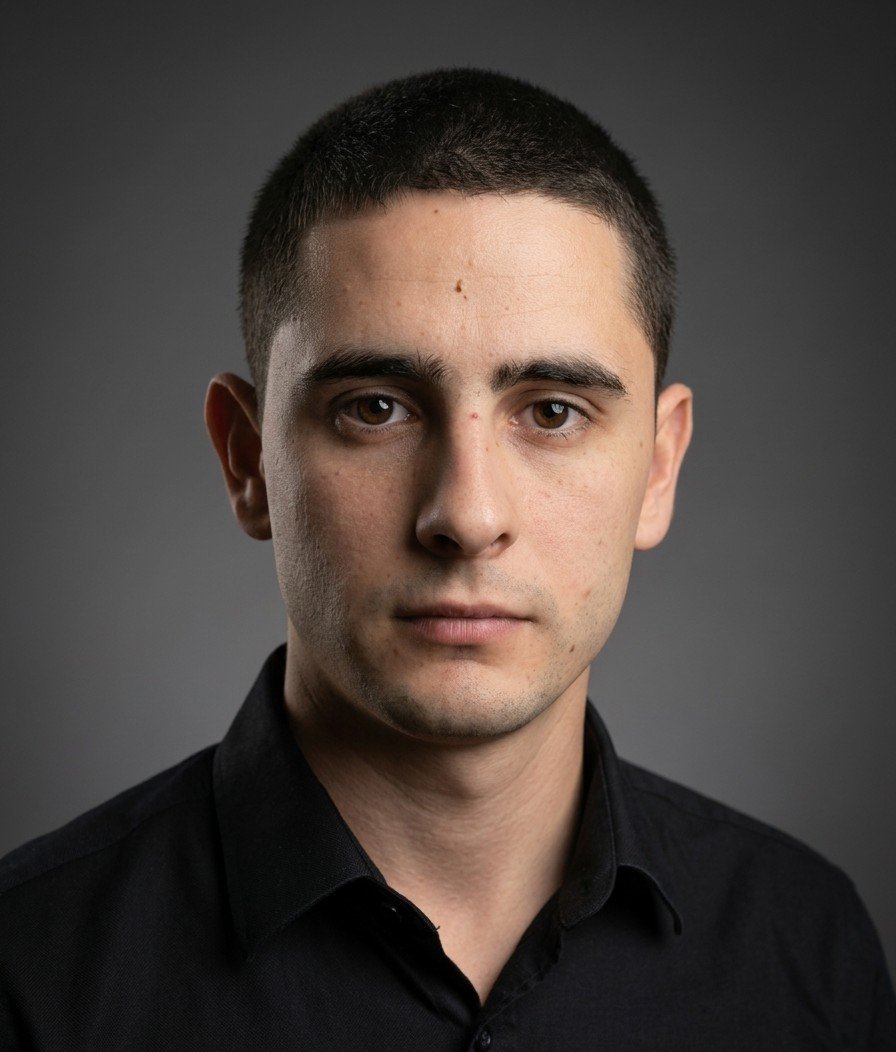
I am Guillem Navarro Vargas, an Industrial Technologies engineer from BarcelonaTech (UPC-ETSEIB). I started out meshing automotive components and today I lead the artificial intelligence department of a 400-engineer company.
That path explains how I work: understand the whole system before optimising any of its parts. I learned it in analysis, where one badly placed assumption invalidates the result however fine the mesh is.
And I didn’t get here alone, nor do I have it all figured out: I learn fast, ask without ego, and surround myself with people who know more than I do in their field. More often than not, the credit belongs to the team.
How I work
Every company along the way left me one pillar, and I went after each on purpose. They rest on the psychology of problem-solving and on the soft skills you can’t compute, and they all serve the same strategy: understand the whole system —from the physical world to the model— before touching a single part.
兵法:一曰度,二曰量,三曰數,四曰稱,五曰勝。地生度,度生量,量生數,數生稱,稱生勝。
The art of war has five steps: measurement, estimation, calculation, balance and victory. The ground gives rise to measurement; measurement to estimation; estimation to calculation; calculation to balance; and balance to victory.
Twenty-five centuries on, it’s still the same order: measure, estimate, calculate, decide. My pillars just give it the name today’s psychology uses.
I won’t touch a part until I understand the system holding it up. Experts read a problem by its structure, not its surface (Chi, Feltovich & Glaser, 1981); I trained that eye running an industrial plant end to end — networks, ERP, IoT — where nothing works in isolation.
I solve a new problem by carrying the solution over from another domain: that is analogical transfer (Gick & Holyoak, 1983), the engine of expert creativity. From finite-element analysis and the electric vehicles I repaired with my hands at Robotic Dreams to the models that now reason over physical systems: that, to me, is physical AI.
I police my assumptions as hard as I run the numbers. Expertise is as much metacognition as technique (Flavell, 1979): in finite elements a bad assumption invalidates the result no matter how fine the mesh — and that holds for a mesh or a business decision alike.
I choose where to work for what I’ll learn, not for what I already know. Expertise comes from practising what you haven’t mastered (Ericsson, 1993); so every company and degree was a decision, and I keep to the frontier: first cohort of Perplexity’s AI Business Fellowship.
A result you can’t defend doesn’t exist. The expert forgets what not-knowing feels like — the curse of knowledge (Camerer et al., 1989) — so I translate on purpose: I defended R&D dossiers before clients and the tax authority at FI Group, and demoed agentic systems live to a non-technical congress at DETCON.
I lead by shared mental model, not by org chart. The best teams think in the same frame (Cannon-Bowers & Salas, 1993); I’ve built that leading communications for Fòrum ETSEIB, broadcasting live for Ràdio Calella Televisió, lending a hand at the European Blockchain Convention, and building an AI department from scratch.
I decide with rigour when time and resources are finite — which is always. That is the real definition of rationality (Simon, 1955), and I sharpened it at Grifols, managing access in a regulated pharmaceutical environment where error is not an option.
And I know what I don’t know: every project reminds me how much is left to learn — and that what turns out well is almost never down to one person alone.
03/2016 — present Ongoing
Networks, IoT, ERP and the plant’s digital backbone. Held alongside everything else ever since.
09/2017 — 09/2018
Pineda de Mar. Diagnosing and repairing electric vehicles: batteries, motors and power electronics learnt hands-on.
09/2018 — 07/2022
UPC · ETSEIB. The foundation of everything. Closed with a thesis whose patent filing I initiated: energy from glucose for implantable devices.
10/2019 — 01/2021
Broadcasting the sports events of the local arena for the town television.
09/2020 — 10/2021
The first team I led: negotiating with companies for the school’s careers forum.
12/2020 — 07/2021
From helpdesk technician to access management: Active Directory and SAP at a pharmaceutical company.
06/2022 — 12/2022
Technical reports and tax deductions, defended in front of the client.
09/2022 — 05/2025
UPC · ETSEIB. Renewables, smart grids, storage and hydrogen.
09/2022 — 05/2025
UPC · ETSEIB. The whole-system view. Closed with two theses: an end-to-end EMS and its business case, embargoed until 2030.
02/2023
Helping hand in the production of one of Europe’s largest blockchain congresses, in Barcelona.
10/2023 — 04/2025
Finite elements on automotive components, with AI entering the simulation workflow.
01/2025 — present Ongoing
UC Berkeley.
2025
Selected for the first cohort of the fellowship: a small group of professionals chosen to drive AI adoption in business.
2025
Generative AI LLMs · Deploying RAG Pipelines for Production at Scale.
04/2025 — present Ongoing
The artificial intelligence department built from nothing, reporting directly to the CEO.
2026
Agentic systems running locally, demonstrated live before the private investigators congress.
05/2026 — 09/2026
UPC School · Schneider Electric. Critical infrastructure: cooling, control and microgrids.
10/2026 — present Not started yet
The other half of the same problem: how the original learns, decides and fails.
From 11/2026 Not started yet
From research to the global market: technology transfer, funding and deep-tech scaling.
In progress
Corporate ecosystem with agents
BTECH · Project lead
It is not one more tool bolted onto the ones already there: it is the layer where all of them meet. Commercial management, resource planning, knowledge base, training, engineering and simulation live in one ecosystem, talk to each other over declared paths and share a single identity. On top, a layer of agents with their own tools that can query any of them, cross-check what one says against another, and act on them where it is entitled to. It reaches every department without exception: leadership, finance, human resources, sales, quality, legal, engineering and production.
The data's journey
Orders, purchasing, stock and costs. The backbone of operations, yet every department exports it its own way and ends up with its own version of the number.
Quotes, contracts, standards and reports. Knowledge that lives in PDFs and emails, and today is only found by asking whoever wrote it.
Real-time plant data: temperatures, consumption, stoppages. Lots of volume and little context unless someone cross-references it with everything else.
Years of projects, incidents and maintenance. The company's memory, spread across folders nobody has time to read.
Every source comes in through a declared path and identifies itself: you know where each piece of data comes from and who may use it. Switch the layer off and you'll see the chaos of ad-hoc integrations.
Data stops being loose rows and becomes connected objects: customer, order, machine, project. A single source of truth everyone queries.
They traverse the map to search, reason and carry out tasks. What used to take weeks of digging now takes minutes, always with the permissions of whoever asks.
Some information isn't for everyone. The agent inherits your permissions: if you can't access a piece of data, neither can it.
Everything runs on in-house servers, inside the company. You know what runs, where and on which data.
GPUs join the cluster as one more resource: drivers, scheduling and measurement of each card’s use, temperature and power draw. It is the layer where watts become tokens, and where the cost of each one is known.
Replicated storage by criticality tier, databases with replicas and automatic failover, caching, object storage and offsite backups every hour. Data that cannot be recovered is data you never had.
Everything is declared in a repository and the cluster reconciles itself against it: deployments, upgrades and job queues on shared GPUs. Nobody deploys by hand and every change has an author and a date.
One identity for people and services, secrets that are never written down anywhere, images verified before deployment, traffic closed by default, isolated workloads and an internet exit that only lets through what is on an allowlist. Personal data is anonymised before it reaches a model.
Metrics, logs, alerts and the trace of every call to a model: tokens, latency and cost. It is the difference between knowing something is failing and hearing it from a user, and what turns token economics into a measurement.
If an outside service is needed, only a query with no sensitive data goes out. Anything confidential hits the dome and stays inside.
A digital twin connected to the map: agents rehearse movements and scenarios before touching reality, with no risk and no downtime.
Every answer can be walked back, from the decision to the source data. No black boxes.
A defensible number, with its reasoning and its sources. Ready to present without rebuilding the spreadsheet.
The system gathers, compares and proposes; a person decides. AI adds judgement, it doesn't replace it.
Animation: scattered data from several sources travels into a shared map of connected objects; agents move across that map and the result arrives as a single decision with its reasoning. It all happens inside a dome: data never leaves the company.
ERP, documents, sensors, records
Before five versions of the same figure, spread across departments.
One map: the ontology that connects it all
Now one source of truth, connected and auditable.
They search, reason and act with permissions
Now weeks of searching, done in minutes.
A defensible figure and its why, traceable
Now every decision with its figure and its why.
The whole journey runs on-premise: data never leaves the building.
3D models: Desktop computer (Poly by Google), Small Stack of Paper (Jarlan Perez), File Folder (Ryan Dewalt), server rack (Jeremy Eyring) and Robot Arm (Yali Izzo), CC BY 3.0, with modified materials, textures and scale; Man (Quaternius), CC0. Sourced from Poly Pizza.
A company’s systems usually speak different languages and none of them knows what the others are doing; when someone needs to cross two, they do it by hand. Here each program communicates with the rest — and with whatever external ones are needed — over a declared path, not through loose integrations nobody remembers who built. That is what turns a collection of applications into a system.
Everything runs on RKE2, the Kubernetes distribution validated to FIPS 140-2 and compliant with DISA STIGs: the one admitted into US federal environments. It is not security decoration. It is what lets an outsider come in and check what encrypts what, who accessed what and when, without the answer being “we would have to look into that”.
It is the same agent for the whole workforce, but it inherits the permissions of whoever invokes it: when a person uses it, it reaches exactly what that person reaches, not one record more. It looks like an implementation detail and it is the piece that decides whether the system can exist at all: without it, a corporate assistant is a data leak with a good interface, and one well-phrased question is enough to pull up somebody’s salary.
A router decides, query by query, whether it is resolved by a model running in-house or one outside. Sensitive material never leaves; what is not sensitive can use the best model available at that moment. Data sovereignty stops being a position defended in meetings and becomes a rule that enforces itself.
Inside the same ecosystem lives a simulation environment where engineering geometry, physics and the models that learn from it share a single scene. Humanoid robotics is trained there against a simulated world before the robot exists: situations are generated that would take months of data collection on a real plant floor, and models that understand image and language at once learn to read them. It is a test bench for something that has not been built yet.
Everything moving from one program to another is visible, measurable and can be cut. A capability is opened to one department and closed to another; a tool is granted to an agent and taken back; a request is followed from whoever made it to the last system it touched. Without that traceability there is no governance, only trust, and trust cannot be audited.
A system like this is, in practice, a digital twin of the company. Not of a part or a plant: of how information moves, who can see what, and how decisions get made. And a twin is good for the same thing here as in engineering — trying the change before making it, and knowing what breaks if it goes wrong.
There is usage data, but it is not public. Neither is the ERP, the commercial system, the simulation environment or the specific architecture.
Tools
What I use to deliver today, plus what I worked with in depth in earlier stages — from CAE simulation to the plant floor — grouped by domain. Each tool carries its level of use, because designing something is not the same as using it or taking it into account.
Click any of them to see where I have used it.
Design & operate: I decided how it is built and keep it running. Hands-on use: I have used it myself on projects. Integrated: I took it into account to fit AI into the company, without being a specialist.
Design & operate Hands-on use Integrated
NVIDIA Omniverse · NVIDIA PhysicsNeMo · NVIDIA Warp · ANSA · Pam-Crash · Abaqus · Meta · SolidWorks · MATLAB and Simulink · Ansys · Autodesk · Robotics simulation
LoRA-fine-tuned LLMs · RAG · Autonomous agents · Memory systems · Nemotron 3 Super · Nemotron 3.5 Lightning · Nemotron 3.5 Content Safety · Nemotron Parse · Cosmos 3 Edge · NVIDIA cuOpt · LangChain · Open WebUI · TensorFlow · Milvus · NVIDIA cuVS · OpenAI API · Whisper · VLMs · Tool-call parsers · TimesFM · Hunyuan-MT 7B · NeMo Retriever · NV-EmbedQA-E5-v5 · Nemotron Rerank · TensorRT & TensorRT-LLM · NVIDIA Dynamo · NVIDIA NIM · NeMo Guardrails · NVIDIA OpenShell · Nemotron VL · Qwen · Llama · Mistral · Gemma · DeepSeek · Claude · Claude Code · ChatGPT · Perplexity · vLLM · LLM gateway and tracing · NVIDIA NeMo Agent Toolkit · Speech and avatar · Microsoft Presidio · Cosmos Reason · Nemotron 3 Nano
Regulation (EU) 2024/1689 · ISO/IEC 42001 · ISO/IEC 27001 · ISO 9001 · TISAX · Use-case risk classification · Conformity assessment
NVIDIA DGX Spark (GB10) · Kubernetes · RKE2 · CUDA · Argo CD · GitLab · Coder · Docker · Istio · Python · Linux and Linux Server · Windows Server · Git · LaTeX · NVLink · NCCL · Dell servers · Token economics · Hardening · Kubernetes platform · Fleet management · Software supply chain · GPU platform · Storage and backup · Databases and caching · Observability · Secrets and identity · Runtime isolation · Base system
Active Directory · authentik · SAP · Azure · Citrix · VPN · Access control · n8n · Wiki.js · Drupal · Jira · Power Automate · Odoo · Moodle
Self-consumption solar · Industrial IoT · ERP · Minitab
Team leadership · Project management · Hiring & onboarding · Executive communication · Negotiation · Mentoring · OKRs & KPIs · Cross-functional work
Trademarks, logos and product names mentioned belong to their respective owners. They are cited solely to describe professional experience with them and imply no commercial relationship, sponsorship or endorsement by their owners.
Credentials
Degrees, certifications and what is under way. What points where I am heading is the postgraduate with Schneider Electric and the NVIDIA certifications.
Agentic systems applied to private investigation
DETCON 2026 · Private investigators congress, Barcelona · 2026
Invited speaker as an artificial intelligence specialist. Agents running locally and in isolation, from an ordinary laptop to an NVIDIA Jetson Orin, with no data leaving the machine. Live demonstration of the whole flow: input over messaging, automatic drafting of the report and follow-up questions on it. Presented as beta-stage technology rather than production, and as the direction the market is taking.
AutoCFD · Automotive CFD Prediction Workshop
International working group · Monthly meetings · 5th edition
I take part in the monthly meetings of the AutoCFD working group — the international workshop that measures how well CFD actually predicts on automotive geometries. My focus there is the road ahead: simulation through machine-learning models, trained on open, high-fidelity CFD data, that predict in seconds what takes a solver hours. It is exactly where classical simulation and physical AI meet —the same crossing I work at every day.
Perplexity · AI Business Fellowship
Program community · First cohort
Part of the technical community of Perplexity’s AI Business Fellowship: a small network focused on bringing AI to real business decisions.
Hugging Face
Open-source community · Models, datasets and robotics
Part of the Hugging Face open-source community: open models and datasets, and the Pollen Robotics hardware I tinker with.
Licences Driving licences A1, A and B · Recreational boat skipper · Drone pilot (AESA) · Open Water Diver (SSI, up to 18 m)
Résumé
A summary of the whole career, condensed onto one sheet. The full CV downloads just below, in three formats and three languages: it is the same document I send out.
Guillem Navarro Vargas
Industrial Engineer · Head of AI at BTECH
Industrial Technologies Engineer from UPC-ETSEIB, with master’s degrees in Energy Engineering and in Industrial Engineering and a postgraduate in data centre energy management from UPC School with Schneider Electric. Head of AI at BTECH, where I built the AI department of a 400-engineer company, reporting directly to the CEO. I work where critical infrastructure, energy and artificial intelligence applied to physical systems meet, with one fixed principle: the machine assembles the metric, the decision stays with a person.
Built the AI department of a 400-engineer company: I proposed the business case, defended it to the leadership and set the area up from nothing, reporting directly to the CEO. Team leadership and cross-departmental work with the rest of the organisation, starting with finance: process automation and KPI and indicator systems, with cases where three months of a person’s annual work came down to hours. A significant part in bringing in Regulation (EU) 2024/1689 and the management framework aligned to ISO/IEC 42001, along with the internal training on both. An AI ecosystem integrated into simulation and CAD workflows, with LoRA-fine-tuned LLMs, RAG, autonomous agents and memory systems on Kubernetes and in-house GPU compute. Token economics and hardening (CIS, DISA STIG, FIPS 140-2) by design: sensitive data never leaves the company.
Finite element analysis on automotive components with ANSA, Pam-Crash, Abaqus and Meta, and integration of LLM engines and RAG architectures into the simulation workflow.
Held alongside the rest of my career. Optimisation of distribution, data transfer, backups, updates and IoT integration. Key part of developing an 86 kW photovoltaic plant and of ERP roll-out across industrial and logistics operations.
Technical reports and direct client relationships. Coordination of grants, tax deductions and social-security rebates, both self-assessed and certified.
Joined as a level-2 helpdesk technician and was promoted to access control management: systems administration, Active Directory and SAP.
Led the corporate communications area and the team within it: negotiation and company relations for the school’s careers forum. The first team I led.
Critical infrastructure end to end: advanced energy management of data centres, innovation in cooling and control systems, and the design and operation of hybrid AC/DC microgrids and uninterruptible power systems.
Kubernetes and RKE2 · NVIDIA DGX Spark, CUDA, TensorRT and NIM · vLLM · RAG and agents · Token economics · Hardening (CIS, STIG, FIPS) · Python · ANSA · Abaqus · Pam-Crash · SolidWorks · MATLAB
A1, A and B · Recreational boat skipper · Drone pilot · Open Water Diver (SSI, up to 18 m)
Catalan and Spanish native · English C1 certified · French A2 certified
Contact
I reply within 48 working hours, written by me: what I understand of the problem, how I would approach it and whether my profile fits.
And if it’s just a question, write anyway — if I can help, I will.